Automotive and Marine Software Services
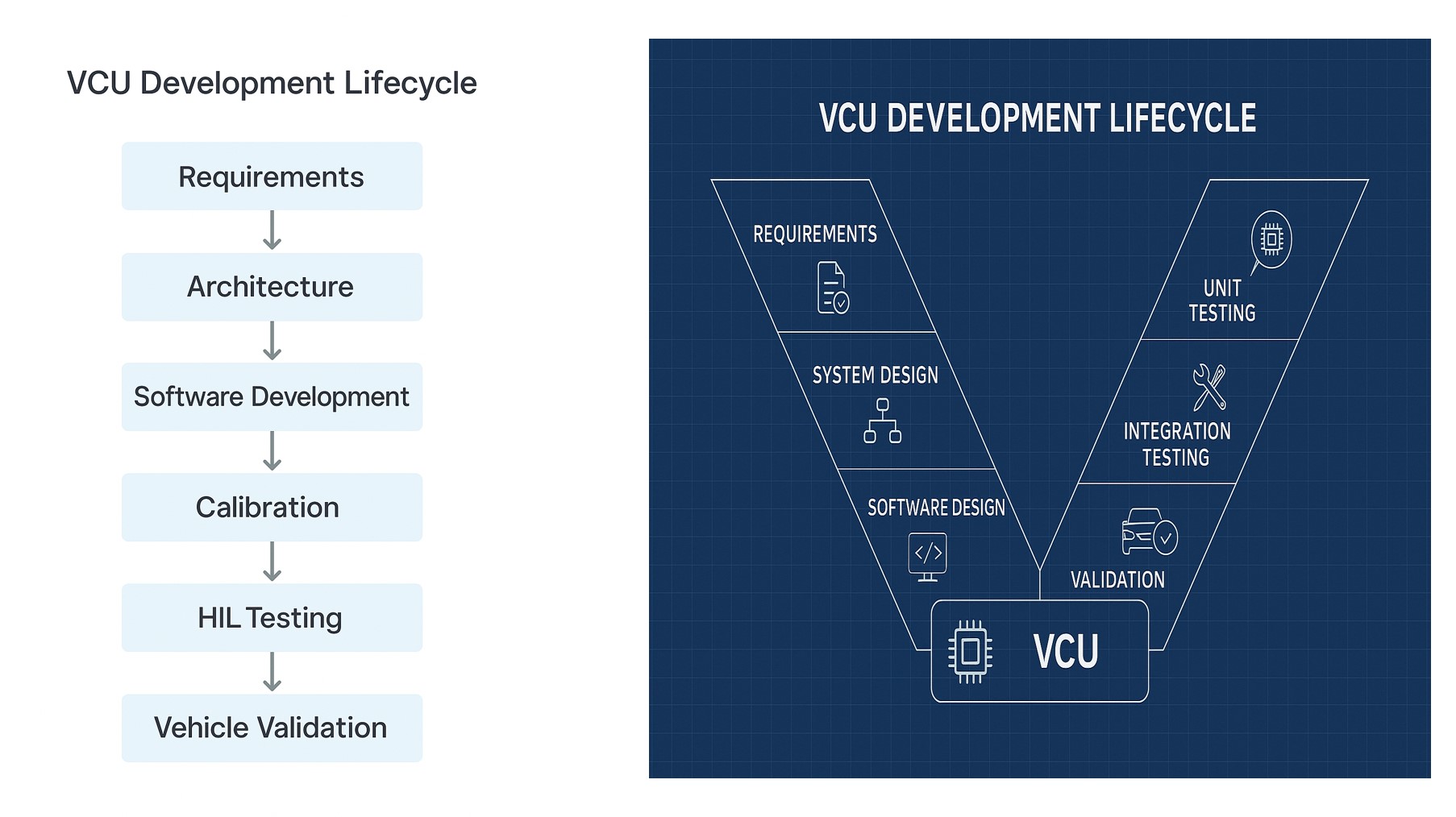
ASPICE-Compliant Software Development Services
End-to-end automotive software engineering aligned with ASPICE (Automotive SPICE) V-Model
We provide full-cycle ECU/VCU software development following ASPICE best practices from SYS.1 to SWE.6, ensuring high process maturity, traceability, and production-ready quality. Our engineering team supports OEMs and Tier-1 suppliers with scalable, standards-compliant development.
Key Capabilities
Process Excellence
ASPICE Level 2/3-capable workflows
Complete documentation (SRD, SDD, SRS, ICD, Test Specs,
Reports)
CI/CD automation for software builds and tests
Compliance with ISO 26262, MISRA C, and OEM development
guidelines
Domains We Support
Electric Powertrain (VCU, MCU, DCDC, OBC)
BMS & HV Safety
ADAS/Body/Chassis ECUs
Telematics & Connected Vehicle Systems
Hybrid Systems & Energy Management
Automotive and Marine Testing
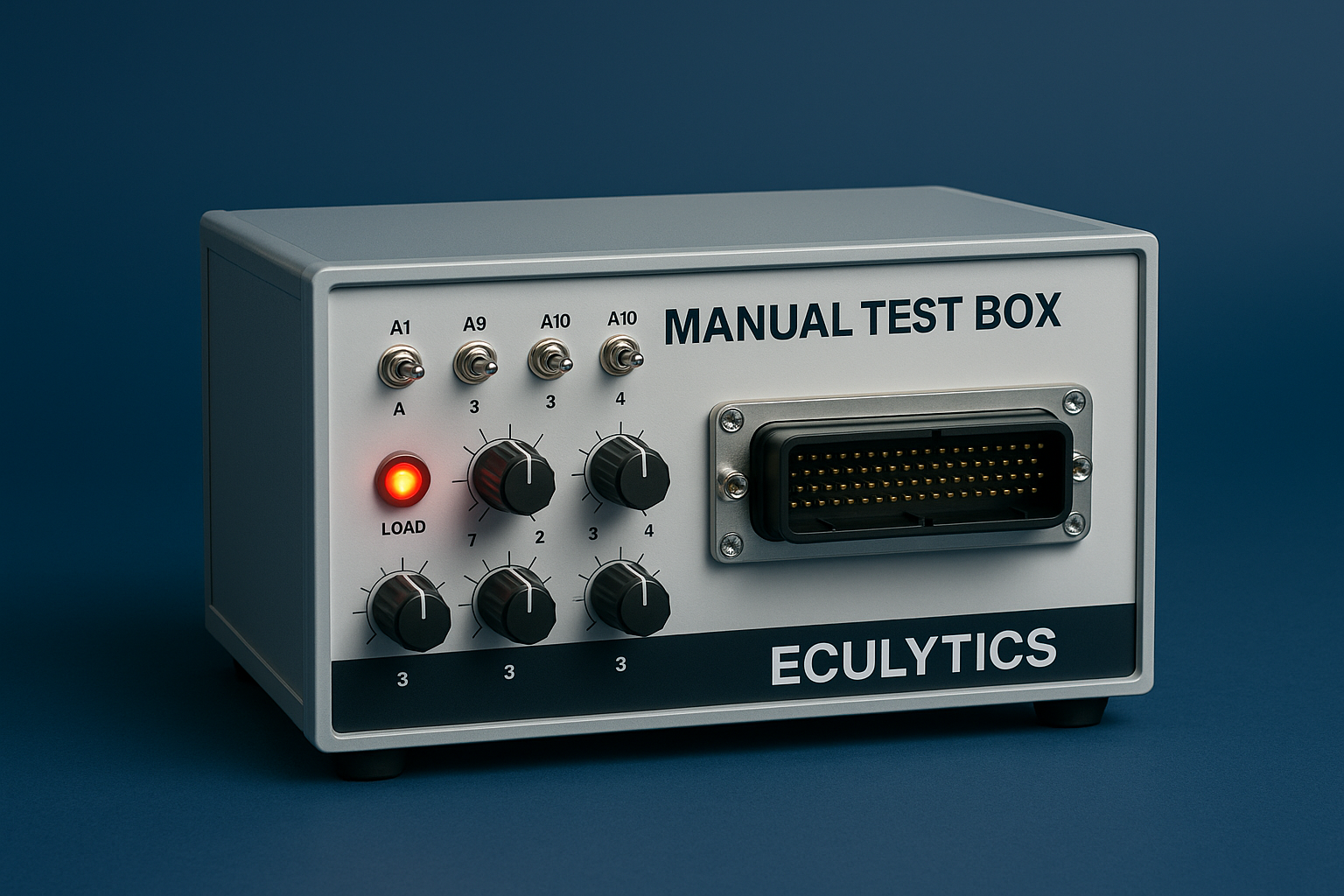
Manual Test Box (Loadbox)
Precision Loadbox Solutions for Professional, Pin-Level ECU Testing
The Manual Test Box is engineered for development teams who require accurate, controlled, and repeatable manual testing of ECUs. Designed to match exact pinout specifications, it delivers a dependable platform for evaluating functionality, robustness, and fault behavior under real-world electrical conditions.
Key Capabilities
-
Tailored interface designed precisely around your ECU’s pin mapping—supporting analog, digital, PWM, LIN, CAN, and power I/O.
-
Ergonomic switches, variable loads, relays, fault injection points, and toggles provide full control to simulate real-world scenarios and edge cases.
-
Delivered with complete wiring diagrams, load descriptions, test procedures, checklists, and validation reports to support structured testing.
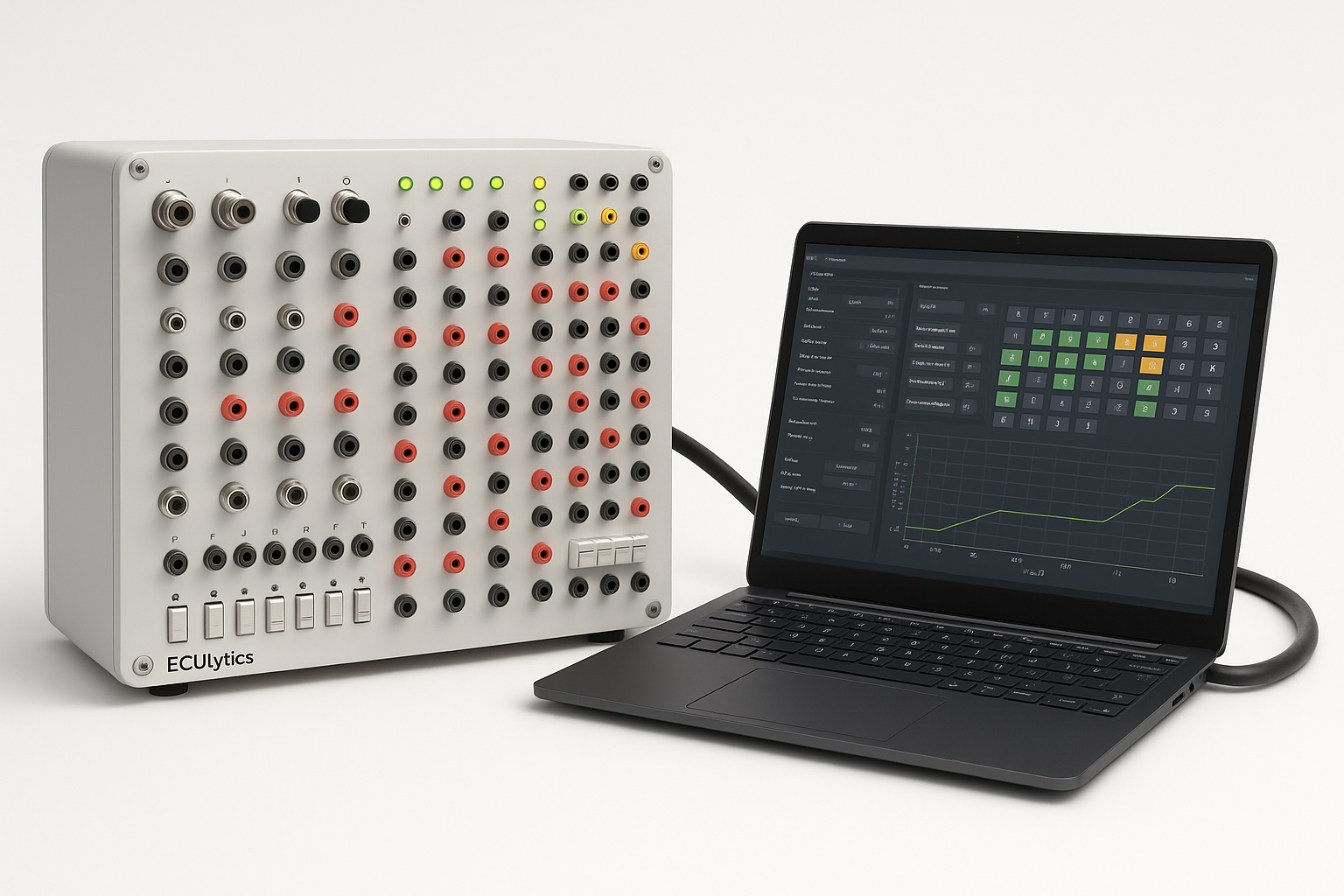
Semi-Automated Loadbox
Next-Level ECU Testing with GUI-Driven Control & Smart Automation
Boost testing efficiency and accuracy with our semi-automated loadbox—designed to eliminate manual effort while ensuring consistent, high-coverage ECU validation. Featuring an intuitive PC-based GUI, engineers can execute complex test actions with a single click.
Key Capabilities
-
Control all pins, loads, and test conditions through a clean, intuitive desktop application.
-
Execute standardized routines instantly—ideal for regression testing, repeated validation cycles, and production checks.
-
Every action, measurement, and result is automatically captured for traceability, reporting, and compliance.
-
Define test limits, thresholds, timing, load levels, and pin behaviors based on your ECU’s requirements.
Automated Test HIL
Advanced Hardware-in-Loop Platform for Full ECU & VCU Automation
Our Automated Test HIL solution delivers end-to-end validation capability by combining real-time simulation, automated execution, and seamless software integration. Designed for high-complexity automotive systems, it enables rapid, repeatable, and fully automated ECU/VCU verification in controlled virtual environments.
Key Capabilities
-
High-fidelity simulation of sensors, actuators, powertrain, chassis, and vehicle dynamics—executed in real time for precise closed-loop behavior.
-
Fully scriptable test sequences with automated execution, monitoring, fault injection, result collection, and reporting.
-
Supports simultaneous testing of multiple ECUs/VCUs with synchronized communication across CAN, CAN-FD, LIN, Ethernet, FlexRay, and analog/digital interfaces.
-
Integrates with CI/CD pipelines (GitLab, Jenkins, Azure DevOps, etc.) for automated nightly runs, regression testing, and continuous validation.

Homologation Readiness Services
Accelerate Certification. Reduce Rework. Launch with Confidence.
Homologation for electric and hybrid vehicles is complex—multiple standards, evolving AIS/CMVR/UN-R rules, and strict behavioural expectations from ECUs, BMS, and powertrain controllers. One failure at the test agency can delay launches by weeks and increase costs significantly.
ECULytics by VG marine closes this gap by preparing your product before it reaches ARAI, ICAT, or GARC etc.
We combine deep expertise in VCU/BMS/MCU software, EV powertrain architectures, and automated HIL testing to ensure your system behaves exactly the way regulations expect.
Our Approach
Understand: We analyse your system, architecture, and
compliance requirements.
Validate: We execute targeted pre-homologation tests using
HIL, simulation, and bench setups.
Optimise: We highlight issues early and support your
engineering team in closing them.
Prepare: We produce agency-ready documentation and
technical submissions.
Support: We accompany you during actual homologation tests
for faster, smoother approvals.
Why OEMs Choose ECULytics by VG marine
Specialised in EV/HEV powertrain, VCU, BMS, and diagnostics
Strong capability in
HIL, test automation, and fault-behaviour validation
Reduces homologation iterations, delays, and cost overruns
Faster time-to-market with
end-to-end documentation and technical support
Flexible engagement—from simple
gap assessments to full lifecycle programs
Our Service Tiers
-
Quick readiness check with actionable findings.
-
Deep behavioural and functional validation to avoid test agency failures.
-
Complete support until product certification.
Requirements Engineering (SYS.1, SYS.2, SWE.1)
Structured capture, refinement, and traceability of system and software requirements using tools like Polarion, DOORS, and PTC.
System & Software Architecture (SYS.3, SWE.2)
Design of modular, reusable, and safety-compliant architectures for powertrain, BMS, chassis, ADAS, diagnostics, and hybrid systems.
Software Unit Design & Implementation (SWE.3, SWE.4)
Model-based development (Simulink) or embedded C/C++ implementation with MISRA, Autosar MCAL integration, and hardware abstraction.
Software Unit & Integration Testing (SWE.5, SWE.6)
HIL/SIL testing, automated scripts, regression testing, interface validation, and coverage analysis.
Configuration & Change Management
Git, SVN, Jenkins CI/CD pipelines, and automated reporting aligned with ASPICE SUP.1/SUP.8.
Verification, Validation & Traceability
Full bidirectional traceability from requirements → design → implementation → tests.